Artificial intelligence is often discussed in marketing in terms of individual effects. Faster content production. Automated campaigns. Personalised communication. But the real value of AI does not come from isolated applications. It arises when several effects come into play simultaneously.
Agentic systems demonstrate precisely this potential. They automate tasks, integrate contextual knowledge and reduce organisational friction at the same time.
The key difference lies less in the technology itself than in how it is embedded in marketing processes.
Three dimensions of value creation
For AI to generate real added value in marketing, three dimensions must interact: productivity, quality and efficiency.
Viewed in isolation, their effect remains limited. Taken together, however, they transform the way entire organisations work.

Productivity through automation
Today, marketing produces more content than ever before. More channels, more target groups, more variants.
Agentic systems can take over a significant part of the operational work involved. They automate repetitive, rule-based or data-intensive tasks.
Examples include generating content variants, evaluating large amounts of data, preparing campaigns and adapting content for different channels.
The effect is clearly measurable: more output in less time.
Quality through adaptive systems
The second lever lies in the quality of the results.
Modern AI systems are not just rule-based. They can also take context into account, recognise patterns, and use feedback to inform future decisions.
In marketing, for example, this means that systems understand target groups better, take performance data into account, and learn from past campaigns. Content, campaign logic and recommendations are therefore continuously evolving.
Consequently, the role of AI is shifting from that of a mere production aid to that of a learning system.
Efficiency through complexity reduction
The third dimension is often underestimated: organisational efficiency.
Marketing communication is heavily influenced by coordination. Briefings, feedback loops, approvals and variant management create considerable friction in processes.
Agentic systems can enable a new process logic. Rules, brand guidelines and decision parameters can be integrated into the system.This results in consistent outcomes with significantly less manual coordination.
In this context, efficiency is primarily achieved through reduced organisational complexity rather than cost reduction.
When the three dimensions come together
The real added value arises where these three levels interact.
- Automation increases productivity.
- Learning ability improves quality.
- System integration increases efficiency.
Thus, agentic systems affect not only individual marketing measures, but also the entire marketing communication process chain
Rather than using isolated tools, an integrated infrastructure is created in which tasks are automated, decisions are data-driven, and processes are simplified.
The following examples demonstrate how such agentic systems are already being used in various areas of marketing today.
CRM mailings: From the target group to HTML ready for dispatch
CRM communication is complex: segmentation, target group logic, market requirements, imagery, text variants, legal notices, template structures.
Our CRM mailing agent automates the creation of appropriate communications almost entirely. It analyses target group segments, consider market specifics into account, generates text variants, understands the context, suggests image motifs and integrates all content directly into existing mailing templates. Translation and format logic can also be included on request.
The result is a brand-compliant, localised, segmented HTML mailing – ready for review. And it’s in the CRM system with just one click.
From wireframe to finished documentation
Digital platforms grow over the years: hundreds of modules, labels, dependencies and variants. Clean documentation is essential and takes a lot of time.
Our specialised multi-agent automatically translates wireframes and briefings into structured specifications. It recognises dependencies, checks legal requirements, integrates pattern libraries and generates Confluence documentation that is ready to use, including tables and HTML specifications.
What used to require several rounds of coordination can now be created through a structured, traceable process. More consistent (independent of human differences) and more efficient than ever before.
Automated checks on quality, compliance and corporate identity
Alongside to classic topics such as strategy, UX/UI, content and software development, the management of complex digital ecosystems increasingly encompasses topics such as accessibility standards, legal requirements (e.g. WCAG or PKW-EnVKV), market-specific regulations and ensuring factual accuracy.
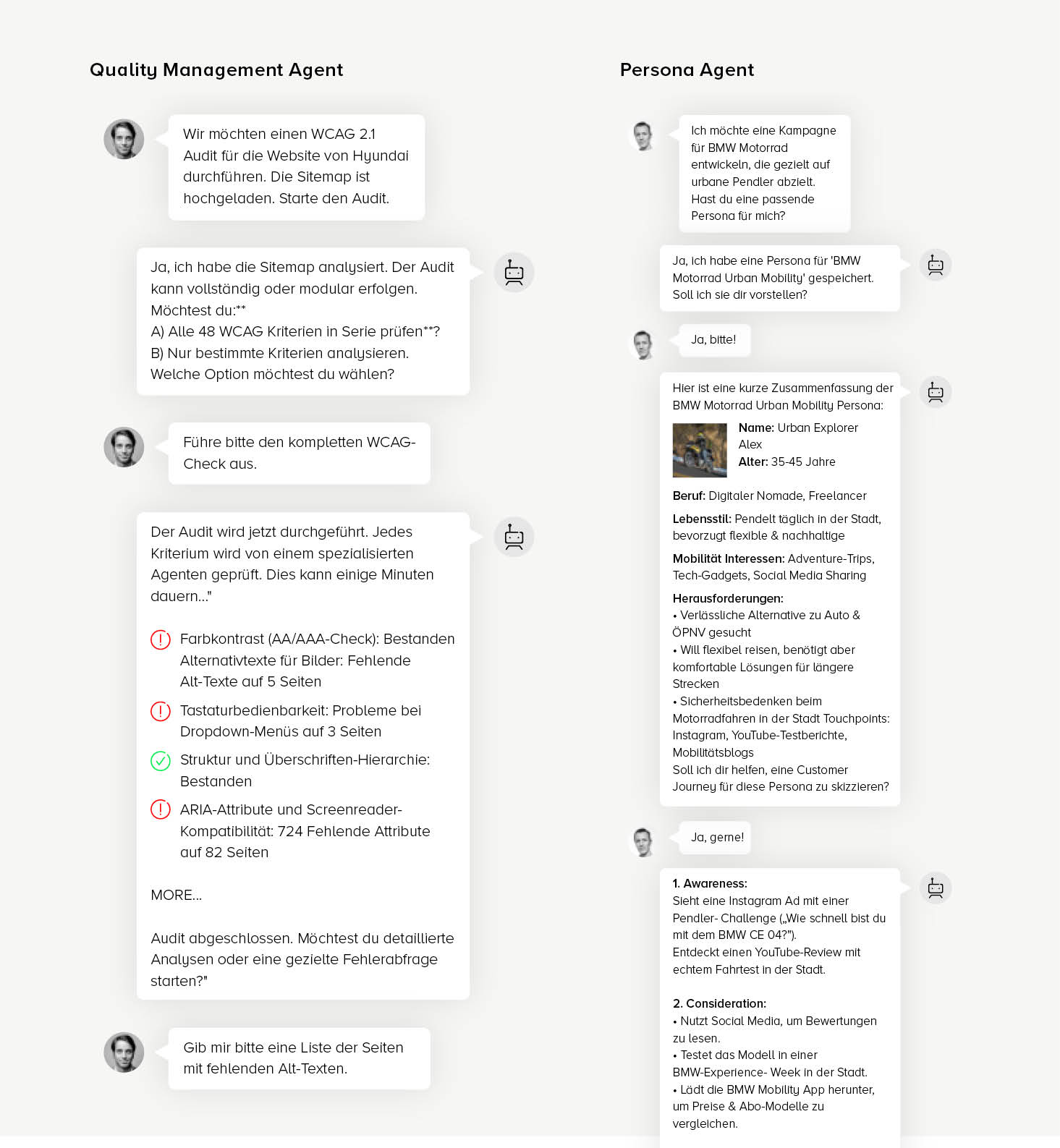
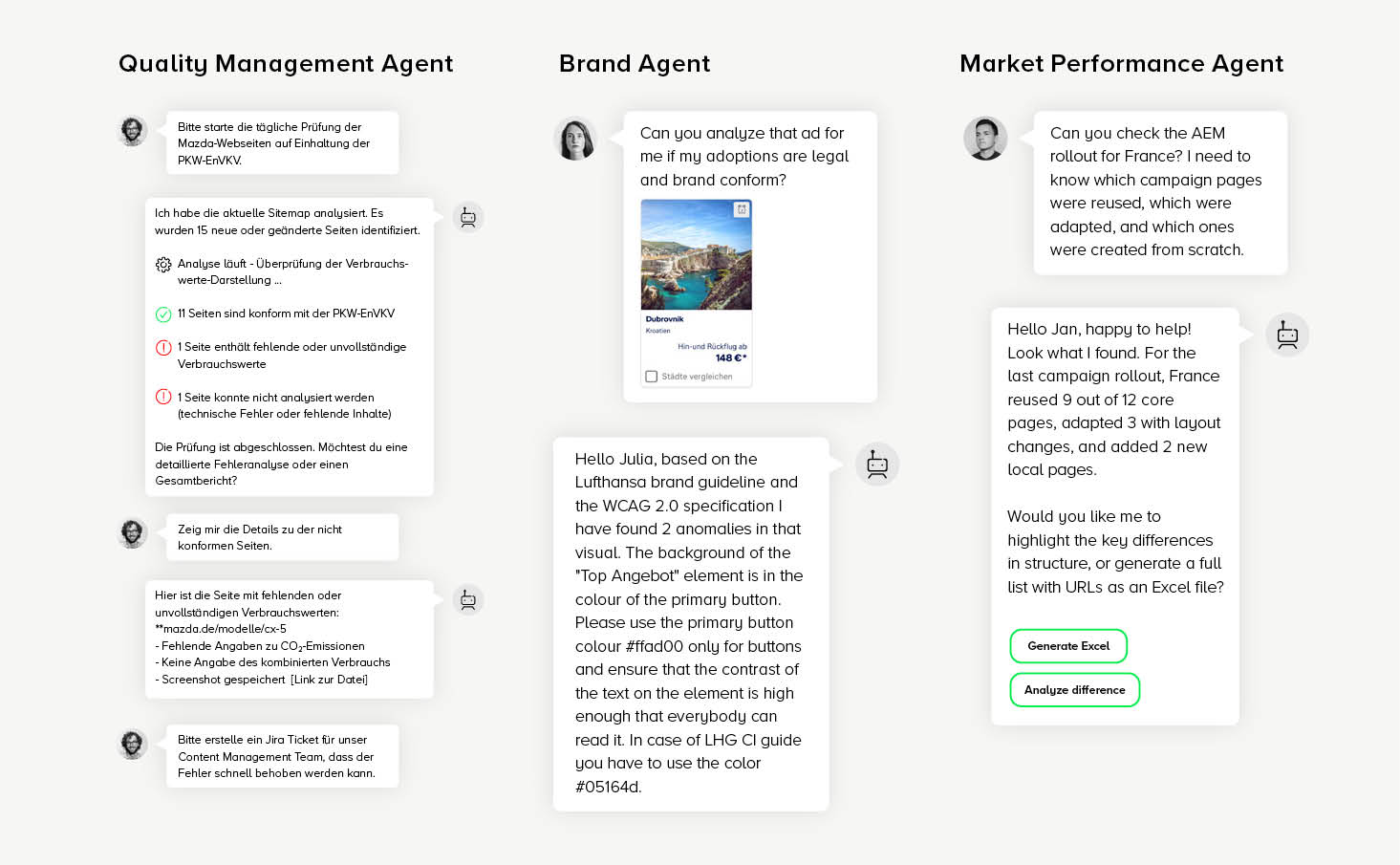
Quality management agents automatically analyse assets, websites or campaign elements. For example, they identify contrast errors, check CI elements against brand guidelines, detect missing alt texts, validate legal requirements and provide specific recommendations for action.
What used to be checked manually – often late in the process – is now integrated and scalable. Quality is not controlled. It is systematically assured.